Phuket (Thai: ภูเก็ต), formerly known as Talang (Tha-Laang) and, in Western sources, Junk Ceylon (a corruption of the Malay Tanjung Salang, i.e. "Cape Salang"), is one of the southern provinces (changwat) of Thailand. Neighbouring provinces are (from north clockwise) Phang Nga and Krabi, but as Phuket is an island with no land boundaries.
 Phuket, which is approximately the size of Singapore, is Thailand’s largest island. The island is connected to mainland Thailand by two bridges. It is situated off the west coast of Thailand in the Andaman Sea. Phuket formerly derived its wealth from tin and rubber, and enjoyed a rich and colorful history. The island was on one of the major trading routes between India and China, and was frequently mentioned in foreign ship logs of Portuguese, French, Dutch and English traders. The region now derives much of its income from tourism.
The name Phuket (of which the ph sound is an aspirated p) is apparently derived from the word bukit in Malay which means "hill", as this is what the island appears like from a distance. The region was formerly referred to as "Thalang" derived from the old Malay "Telong" which means "Cape". The northern district of the province, which was the location of the old capital, still uses this name.
History
 In the 17th century, the Dutch, the English, and from the 1680s the French, competed with each other for trade with the island of Phuket (the island was named Junkseilon at that time), which was valued as a very rich source of tin. In September 1680, a ship from the French East India Company visited Phuket and left with a full cargo of tin. In 1681 or 1682, the Siamese king Narai, who was seeking to reduce Dutch and English influence, named Governor of Phuket the French medical missionary Brother René Charbonneau, a member of the Siam mission of the Société des Missions Etrangères. Charbonneau held the position of Governor until 1685.
In 1685, king Narai confirmed the French tin monopoly in Phuket to a French ambassador, the Chevalier de Chaumont. Chaumont's former maître d'hôtel Sieur de Billy was named governor of the island. The French were expelled from Siam in 1688 however, following the 1688 Siamese revolution. On April 10, 1689, the French general Desfarges led an expedition to re-capture the island of Phuket in an attempt to restore some sort of French control in Siam. The occupation of the island led nowhere, and Desfarges returned to Pondicherry in January 1690.
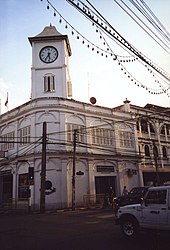
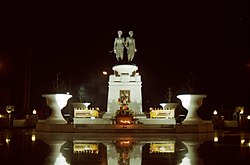
The Burmese attacked Phuket in 1785. Captain Francis Light, a British East India Company captain passing by the island, sent word to the local administration that he had observed Burmese forces preparing to attack. Than Phu Ying Chan, the wife of the recently deceased governor, and her sister Mook then assembled what forces they could. After a month-long siege, the Burmese were forced to retreat March 13, 1785. The two women became local heroines, receiving the honorary titles Thao Thep Kasattri and Thao Si Sunthon from King Rama I. During the reign of King Chulalongkorn (Rama V), Phuket became the administrative center of the tin-producing southern provinces. In 1933 Monthon Phuket (มณฑลภูเก็ต) was dissolved and Phuket became a province by itself. Old names of the island include Ko Thalang.
2004 Tsunami
 On December 26, 2004, Phuket and other nearby areas on Thailand's western coast suffered extensive damage when they were struck by the Boxing Day tsunami caused by the 2004 Indian Ocean earthquake. The waves destroyed several highly populated areas in the region, killing as many as 5,300 people nationwide, and tens of thousands more throughout the wider Asian region. As many as 250 people were reported dead in Phuket including foreign tourists and as many as a thousand unreported deaths of illegal Burmese workers building new beach resorts in the Khao Lak area. Almost all the major beaches on the west coast, especially Kamala, Patong, Karon and Kata, sustained major damage, with some damage also being caused to resorts and villages on the island's southern beaches.
By February 2005 many damaged and most undamaged resorts were back in business, and throughout 2005 life slowly returned to normal for the people of Phuket. Following strenuous recovery programs, there is no remaining tsunami damage other than at the most remote beaches.

In the beginning of December 2006, Thailand launched the first of 22 U.S.-made tsunami-detection buoys to be positioned around the Indian Ocean as part of a regional warning system against giant waves caused by earthquakes under the sea. The satellite-linked deep-sea buoy will float 1,000 km (620 miles) offshore, roughly midway between Thailand and Sri Lanka.
Geography
Phuket is the biggest island in Thailand, located in the Andaman Sea of southern Thailand. The island is mostly mountainous with a mountain range in the west of the island from the north to the south. The mountains of Phuket form the southern end of the Phuket mountain range, which ranges for 440 kilometres (270 mi) from the Kra Isthmus. The highest elevation of the island is Mai Thao Sip Song (Twelve Canes), at 529 metres (1,736 ft) above sea level.
 It is estimated that Phuket has a total area of approximately 570 square kilometres (220 sq mi) (including the province's other islands). Phuket is approximately 536 miles (863 km) south of Bangkok, and covers an area of approximately 543 square kilometres (210 sq mi) excluding small islets. It is estimated that if all its 39 other small islands are included, Phuket Province will cover an area of approximately 590 square kilometres (230 sq mi). The island total length, from north to south, is estimated at 30 miles (48 km) and 13 miles (21 km) wide.
Phuket's topology is exceptional with 70 percent of its area covered with mountains which stretch from north to south and the remaining 30 percent being plains located in the central and eastern parts of the island. The island does not have any major rivers except for a total of 9 brooks and creeks.
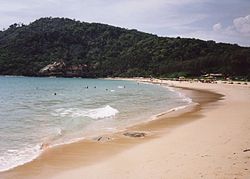
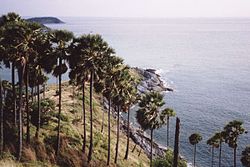
 Forest, rubber and palm oil plantations cover 60% of the island. The western coast has several sandy beaches, while on the east coast beaches are more often muddy. Near the southernmost point is Laem Promthep (Brahma's Cape), which is a popular sunset viewing point. In the mountainous north of the island is the Khao Phra Thaeo Non-hunting Area, protecting more than 20 km² of rainforest. The three highest peaks of this reserve are the Khao Prathiu (384 metres (1,260 ft)), Khao Bang Pae 388 metres (1,273 ft) and Khao Phara 422 metres (1,385 ft). The Sirinat National Park on the northwestern coast was established in 1981 and protects an area of 90 square kilometres (35 sq mi) (68 kilometres (42 mi) marine area), including the Nai Yang beach where sea turtles lay their eggs.
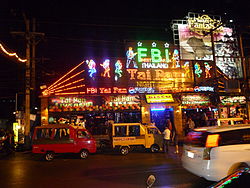
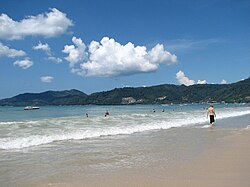
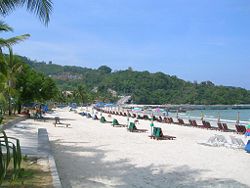
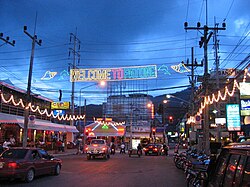
One of the most popular tourist areas on Phuket is Patong Beach on the central western coast, perhaps owing to the easy access to its wide and long beach. Most of Phuket's nightlife and its cheap shopping is located in Patong, and the area has become increasingly developed. Patong means "the forest filled with banana leaves" in Thai. Other popular beaches are located south of Patong. In a counterclockwise direction these include Karon Beach, Kata Beach, Kata Noi Beach, and around the southern tip of the island, Nai Harn Beach and Rawai. To the north of Patong are Kamala Beach, Surin Beach and Bang Tao Beach. These areas are generally much less developed than Patong, and sought out by individuals, families and other groups with a preference for more relaxed and less crowded environs than Patong. There are many islands to the southeast, including Bon Island, just a short boat trip away. There are several coral islands to the south of Phuket, the Similan Islands lie to the northwest, and Phi Phi Islands to the southeast. Islanders engage in a lively tourist trade, catering to snorkelers and scuba divers.
Attractions
- Two Heroines Monument (อนุสาวรีย์วีรสตรี), a famous monument in Amphoe Thalang, is the memorial statue of the heroines Thao Thep Kasattri (Kunying Jan) and Thao Sri Sunthon (Mook), who rallied islanders in 1785 to repel Burmese invaders. As the island's governor had just died, organizing Phuket's defense against the Burmese invasion of 1785 was conducted by his widow, Thao Thep Kasattri. With her sister's help, they assembled what forces they had, then cleverly disguised local women as male soldiers, thus appearing to increase Phuket's military manpower. After a month's siege, the Burmese invaders became exhausted and retreated. King Rama I awarded Kunying Jan with the royal title of Thao Thep Kasattri.
- Wat Chalong (วัดฉลองหรือวัดไชยธาราราม) is where stands the cast statue of Luang Poh Chaem, who helped the people of Phuket put down the Angyee, or Chinese Coolie Rebellion, in 1876 during the reign of Rama V. There are also statues of Luang Poh Chuang, and Luang Poh Chaem, abbots of the temple during later times.
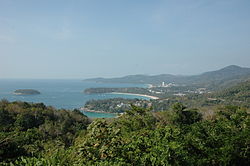
Hat Patong (หาดป่าตอง) (Patong Beach) is Phuket's most developed beach and is 3 kilometres (1.9 mi)-long. It is located 15 km from Phuket town. Patong is mostly made up of hotels, restaurants, nightclubs and various tourist attractions. Daytime activities are primarily centered around the beach with many watersport activities available. Patong is equally well known for its nightlife, centered around Soi Bangla. Patong is also the cheap shopping option in Phuket selling items from clothes, fashion accessories to souvenirs. The northern end of Patong Bay is called Kalim and is a popular place for viewing the sunset and between April and September each year for surfing.

Hat Karon (หาดกะรน) is the second largest of Phuket's tourist beaches, approximately 20 kilometres (12 mi) from town. Large resort complexes line the road behind the shoreline, but the long, broad white sand beach itself has no development. Numerous restaurants and tourist stores are located across the street from the beach. The southern point has a fine coral reef stretching toward Kata and Bu Island. There is also its sister beach Karon Noi.

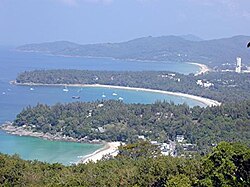
- View Point (จุดชมวิว) This is located midpoint between Nai Han and Kata beaches. The scenic Kata Noi, Kata, and Karon beaches, and Ko Pu Island can be viewed from this point.
Laem Phromthep (แหลมพรหมเทพ) (Phromthep Cape) is a headland forming the extreme south end of Phuket. "Phrom" is Thai for the Hindu term "Brahma", signifying purity, and "Thep" is Thai for 'God'. Local villagers used to refer to the cape as "Laem Chao", or the God's Cape, and it was an easily recognizable landmark for the early seafarers traveling up the Malay Peninsula from the sub-continent.
- Thalang National Museum (พิพิธภัณฑสถานแห่งชาติ ถลาง) is located near the Two Heroines Monument. In 1985, on the 200th anniversary of the Thalang War, the Thalang National Museum was established. The museum contains a permanent exhibition of life in old Phuket, ancient artefacts and remains discovered on the coast, and materials used during war with Burma (Myanmar).
- Khao Phra Thaeo Wildlife Conservation Development and Extension Centre (สถานีพัฒนาและส่งเสริมการอนุรักษ์สัตว์ป่าเขาพระแทว) is a center for study of the environment. Its duty is to promote and distribute wildlife within Khao Phra Thaeo wildlife park. The park is full of virgin forest and also actively conserves a number of wild animals; they would otherwise be extinct in Phuket. Giant trees supported by huge buttresses are thick with creepers and climbers of every description.
Source: http://en.wikipedia.org/wiki/Phuket_Province
Images: http://commons.wikimedia.org/wiki/Category:Phuket